
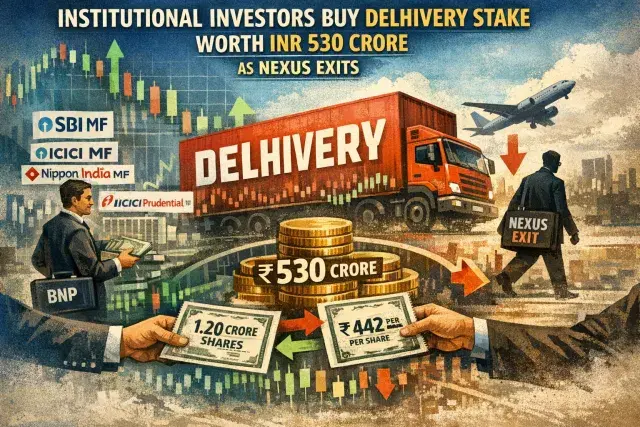

Six institutional investors have collectively acquired a 1.6 per cent stake in Delhivery, one of India's largest third-party logistics providers, through block deals on the National Stock Exchange valued at approximately INR 530 crore. The transaction, executed at an average price of INR 442 per share, involved around 1.20 crore equity shares and signals continued institutional appetite for exposure to India's expanding logistics sector. Shares of Delhivery closed 3.57 per cent higher at INR 457.80 on the NSE following the deal.
Who Bought, Who Sold, and at What Price
The buyers represent a cross-section of domestic and international institutional capital. BNP Paribas, SBI Mutual Fund, Edelweiss Mutual Fund, Nippon India Mutual Fund, AlphaGrep Investment Management, and ICICI Prudential Life Insurance Company each acquired portions of the block. The diversity of the buyer group — spanning global banking, domestic mutual funds, and insurance capital — reflects broad-based conviction rather than a single concentrated bet on the company's prospects.
On the other side of the transaction, US-based venture capital firm Nexus Venture Partners offloaded the shares through two affiliates: Nexus Ventures III Ltd and Nexus Opportunity Fund Ltd. The sale is consistent with a pattern the firm has established since Delhivery's listing, monetising its early-stage investment in measured tranches rather than exiting all at once. In the prior year, Nexus divested a 1.6 per cent stake for INR 461 crore; before that, it sold a 1.06 per cent stake for INR 344 crore. The cumulative value recovered across these transactions underscores the meaningful returns early-stage backers have captured as the company's market valuation matured post-listing.
The Logic of Gradual Exits by Early Investors
Partial stake sales by venture capital firms in listed portfolio companies have become a defining feature of India's new-age public markets. Early investors in pre-IPO companies accumulate large positions built over years of private funding rounds. Once a company lists, full liquidation in a single transaction is rarely viable — it would compress the share price, signal a lack of confidence to the market, and invite regulatory scrutiny depending on the quantum involved. Structured block deals, negotiated off-exchange and then reported as bulk transactions, allow sellers to exit at a pre-agreed price while institutional buyers acquire meaningful positions without moving the open market adversely.
For Nexus Venture Partners, the strategy has been deliberate and measured. Each tranche has been sized to find buyers without disrupting the stock, and each has attracted fresh institutional participation — evidence that the secondary market for Delhivery's shares remains liquid and credible. The post-deal price rise to INR 457.80, above the block deal price of INR 442, suggests the transaction was absorbed cleanly and that broader market participants interpreted the institutional buying as a vote of confidence rather than a distress signal.
What Delhivery Represents in India's Supply Chain Landscape
Delhivery occupies a significant position in India's third-party logistics ecosystem. The company operates an asset-light, technology-integrated network that serves e-commerce clients, direct-to-consumer brands, and business-to-business freight customers. Its scale — built on an extensive sorting and distribution infrastructure spanning the country — gives it a structural advantage in a market where last-mile delivery density determines profitability.
India's logistics sector has expanded in step with e-commerce growth, which itself has been driven by rising smartphone penetration, improving rural connectivity, and the formalisation of retail supply chains following GST implementation. Third-party logistics providers like Delhivery sit at the intersection of these trends: they benefit from volume growth without bearing the inventory risk that afflicts pure-play retailers. That positioning makes them attractive to institutional investors seeking exposure to consumption growth through an infrastructure lens rather than a brand or product one.
The participation of insurance and mutual fund capital in this transaction is particularly notable. Domestic institutional investors in India have historically been more conservative in their allocation to new-age listed companies, many of which carry high valuations relative to current earnings. Their presence here suggests Delhivery's financial trajectory — including its path toward sustained profitability — has met thresholds that more conservative mandates require before committing capital.
Outlook: Sustained Institutional Interest in a Maturing Sector
The broader implication of this transaction extends beyond a single block deal. It reflects a maturing dynamic in India's public equity markets, where the initial volatility that often follows a high-profile listing gives way to a more stable institutional ownership structure. As early backers like Nexus systematically reduce their holdings, their shares are absorbed by longer-duration investors — mutual funds, insurers, and global asset managers — whose investment horizons better match the time it takes for large-scale logistics infrastructure businesses to compound value.
Delhivery itself continues to operate in a sector where competitive intensity is real — both from traditional freight operators modernising their technology stacks and from well-capitalised e-commerce platforms that have built or are building captive logistics arms. Whether the company's network depth and data advantages translate into durable margin improvement will determine how the current institutional interest is rewarded. For now, the demand for its shares at a meaningful price suggests the market's assessment remains constructive.

